From active recall to vocabulary trainers — here you will find the most important terms around spaced repetition, flashcards, and effective learning explained clearly and accessibly.
Active recall is a learning strategy in which information is actively retrieved from memory rather than passively re-read or re-listened to. When you flip a flashcard and try to remember the answer before looking at the back, you are using active recall.
Numerous cognitive science studies confirm that active recall is significantly more effective than passive review. The reason: actively retrieving information strengthens the neural pathway to the stored knowledge, consolidating the memory long-term. Passive reading, by contrast, only creates a feeling of familiarity without actually training the retrieval pathways.
ClassCards consistently implements active recall: in all practice modes — flashcards, typing mode, and quiz — students must produce the answer themselves before receiving feedback.
Ebbinghaus Forgetting Curve
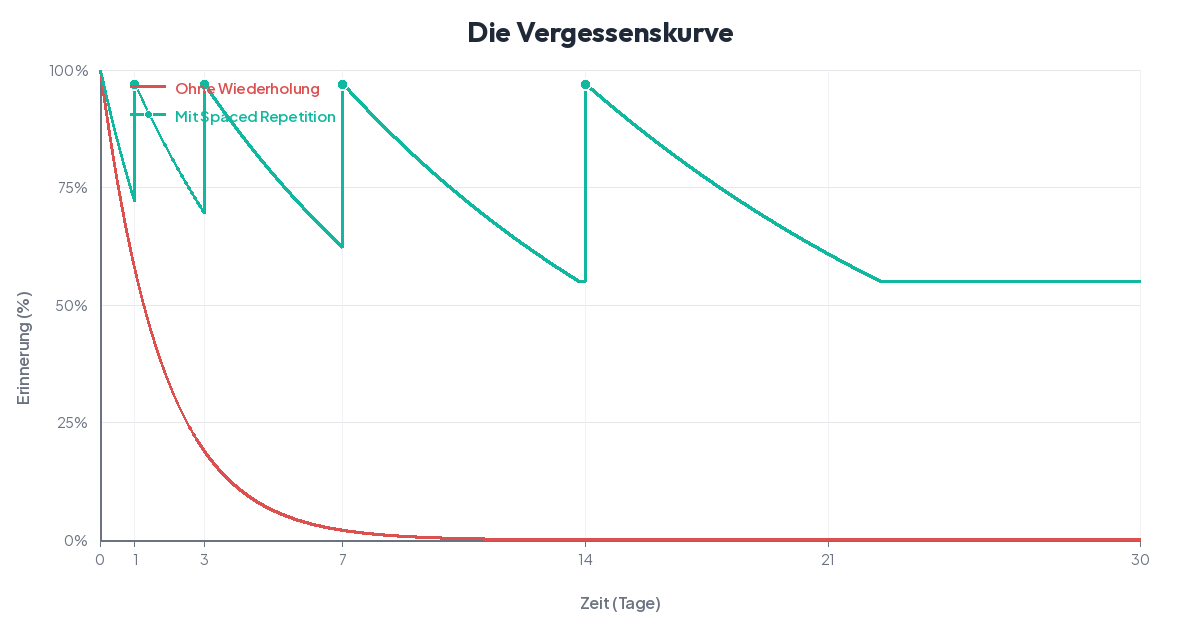
The forgetting curve was described in 1885 by German psychologist Hermann Ebbinghaus. In his self-experiments with nonsense syllables, he discovered that newly learned material is forgotten exponentially without review: after just one hour, about 50% is lost; after a day, around 70%; and after a week, up to 90%.
Ebbinghaus also showed that each review flattens the curve. With targeted refreshers at increasingly longer intervals, knowledge can be permanently anchored in memory. This insight forms the scientific foundation for spaced repetition.
Modern algorithms like FSRS use the principles of the forgetting curve to calculate the optimal review time for each individual flashcard — precisely when the memory is beginning to fade but is still retrievable.
FSRS (Free Spaced Repetition Scheduler)
FSRS is a modern spaced repetition algorithm developed by Jarrett Ye. It is the successor to the widely used SM-2 algorithm from the 1980s and uses machine learning to calculate review intervals with considerably greater precision.
Unlike older algorithms, FSRS takes into account not just the most recent rating but the entire learning history of a card. It models the probability of forgetting mathematically and continuously adapts intervals to individual learning behavior. Studies show that FSRS achieves the same learning outcomes with fewer reviews than SM-2.
ClassCards uses FSRS as its default algorithm. Anki, the most widely used open-source flashcard software, has also adopted FSRS as its preferred scheduler. For teachers and students, this means: less effort, better results. Learn more about the ClassCards vocabulary trainer.
Gamification in Education
Gamification refers to the use of game-like elements in a non-game context — such as school instruction. This includes experience points (XP), levels, streaks (consecutive study days), badges, and leaderboards. The goal is to increase intrinsic motivation and reward positive learning behavior.
In educational research, gamification is a debated topic. Proponents emphasize its motivating effect, especially for younger learners. Critics warn against over-focusing on extrinsic rewards. The key is balance: gamification elements should support learning, not replace it.
ClassCards integrates gamification thoughtfully: students earn XP for regular practice, can see their streak, and unlock achievements. The focus always remains on learning progress. Teachers can enable or disable the XP feature per class. Learn more in our feature overview.
Spaced Repetition
Spaced repetition is a learning method based on a simple principle: reviews are scheduled at increasingly longer intervals. Instead of cramming all flashcards the night before a test (massed practice), learning is distributed over days and weeks (distributed practice).
The scientific foundations go back to Hermann Ebbinghaus's experiments in 1885. Since then, the spacing effect — the observation that distributed learning is more effective than massed learning — has been confirmed in over a thousand studies. It is one of the most thoroughly researched phenomena in learning psychology.
Modern spaced repetition systems (SRS) use algorithms to calculate the optimal review time for each individual learning item. The best-known algorithms are SM-2 (developed in 1987 by Piotr Wozniak for SuperMemo) and the more recent FSRS (Free Spaced Repetition Scheduler), which uses machine learning to determine intervals even more precisely.
ClassCards uses FSRS to schedule vocabulary reviews fully automatically. Teachers create the flashcards, students practice — and the algorithm works in the background to ensure each card is reviewed exactly when the memory begins to fade. The result: less study time, better outcomes, long-term retention. Learn more about the ClassCards vocabulary trainer.
Flashcard Box / Leitner System
The Leitner system was popularized in the 1970s by German science journalist Sebastian Leitner. It is one of the best-known physical systems for spaced repetition and works with several compartments (boxes). New cards start in box 1 and advance one box with each correct answer. Box 1 is reviewed daily, box 2 every two days, box 3 weekly, and so on.
The Leitner system shaped flashcard learning in schools for decades and is still a good introduction to the principle of spaced repetition. However, it has limitations: the fixed intervals do not account for the individual difficulty of a word or personal learning behavior. Manual management is also time-consuming.
Digital flashcard systems like ClassCards build on the core idea of the Leitner system but replace the rigid boxes with flexible, algorithmically calculated intervals. This combines a proven principle with modern technology. Learn more about digital flashcards with ClassCards.
Long-Term Memory
Long-term memory is the part of our memory system that can store information for hours, days, years, or an entire lifetime. Unlike working memory (short-term memory), which holds information for only a few seconds and is limited to roughly 7 items, long-term memory has a virtually unlimited capacity.
For a flashcard to move from working memory into long-term memory, it must be processed through a process called consolidation. Reviews, emotional connections, and sleep all play a central role. The forgetting curve shows that without review, most new information is lost within a few days.
Spaced repetition is the most effective known method for deliberately anchoring information in long-term memory. Each review at the right time strengthens synaptic connections and extends storage duration. ClassCards uses this principle to ensure that flashcards are available not just for the next test, but long into the future.
Retrieval Practice
Retrieval practice is a learning strategy closely related to active recall. The term is used especially in English-language research and refers to the deliberate practice of retrieving information from memory as a learning method — not just as a testing method.
The groundbreaking studies by Henry Roediger and Jeffrey Karpicke (2006) showed that testing one's own knowledge is more effective than repeated reading — even when errors are made during testing. This so-called "testing effect" is one of the most robust findings in cognitive psychology and has been confirmed in hundreds of follow-up studies.
In practice, this means: self-quizzing is far superior to re-reading a text or a vocabulary list. ClassCards makes retrieval practice the standard method: whether in flashcard mode, typing mode, or quiz — students produce the answer actively before receiving feedback.
Distributed Practice (Spaced Practice)
Distributed practice — also called spaced practice — refers to the strategy of spreading learning sessions over time rather than concentrating them in a single session. It is the opposite of massed practice ("cramming"), in which all material is studied in one long session shortly before a test.
Decades of research show that distributed practice leads to significantly better long-term retention. The reason lies in the biology of memory: each time a memory is retrieved and reconsolidated, the underlying neural connections are strengthened. Multiple shorter sessions spread over days and weeks create more opportunities for reconsolidation than a single marathon session.
ClassCards encourages distributed practice through its spaced repetition system: students receive only the cards that are due for review on a given day, preventing both cognitive overload and pointless over-reviewing of well-known material. Learn more about spaced repetition.
Vocabulary Trainer
A vocabulary trainer is a tool for systematically learning and reviewing vocabulary. In its traditional form, this might be a set of paper flashcards or a Leitner system with several compartments. Digital vocabulary trainers automate this process and offer additional features such as progress tracking, multiple practice modes, and algorithm-driven review scheduling.
The advantages of a digital vocabulary trainer over analogue methods are numerous: no paperwork, no lost cards, automatic review planning, practice on any device, and — particularly valuable for teachers — real-time insight into the entire class's learning progress. At the same time, the proven core principle of the flashcard is preserved: one question, one answer, active retrieval.
ClassCards is a digital vocabulary trainer built specifically for use in schools. Unlike general flashcard apps, ClassCards offers integrated class management, a teacher dashboard with progress overview, and GDPR-compliant data storage on EU servers. Teachers get 6 months of full free access; after that, Premium is €15/year. Students always use ClassCards free of charge — ad-free. Find out more: The free vocabulary trainer for schools.